

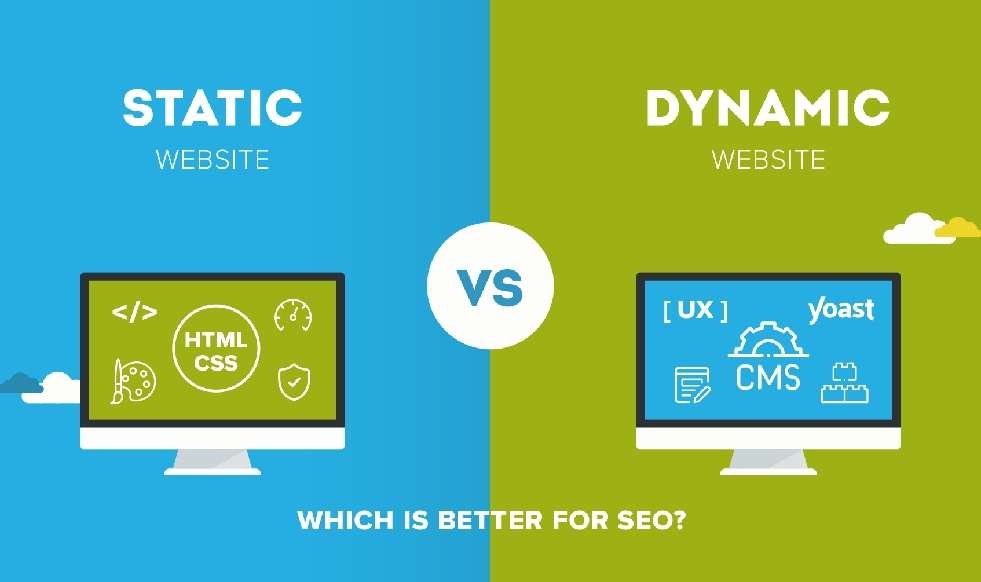
Static vs Dynamic Websites in 2026- Which One is Best for SEO?
In 2026, SEO strategies continue to evolve as search engines become smarter, user expectations grow, and website performance standards rise. One major decision that businesses and developers still face is: Should you choose a static website or a dynamic website for better SEO?
To answer this, let’s dive deep into how each type works, their advantages and disadvantages, and how they influence search engine optimization in 2026.
What Is a Static Website?
A fixed HTML, CSS and JavaScript code constitutes a static site. Individual pages are individual files stored in a server. When a user access the site, the server replies to it by directly sending the page without having to create it dynamically.
Key Features of Static Websites:
- Pre-rendered pages
- Extremely fast page loading
- Lower hosting cost
- High security due to no database or server-side processing
Best For:
- Portfolios
- Small business sites
- Landing pages
- Documentation
What Is a Dynamic Website?
A dynamic website generates pages in real time. Content is pulled from a database or content management system (CMS) like WordPress, Shopify, Drupal, or custom backend frameworks.
Key Features of Dynamic Websites:
- Personalized content
- Easier content management
- Scalable for large and complex sites
- Suitable for blogs, eCommerce, membership sites
Best For:
- Blogs with frequent updates
- News portals
- eCommerce platforms
- Social networks
- SaaS dashboards
SEO Comparison: Static vs Dynamic Websites (2026)
Here’s a breakdown of how each type performs in key SEO areas that matter today.
(A) Page Speed & Core Web Vitals
Speed is still one of Google’s strongest ranking factors.
Static Websites
(Excellent)
Static websites load incredibly fast because:
- No server-side processing
- No database queries
- Content is delivered instantly
Result:
Static sites often achieve near-perfect Core Web Vitals scores, improving rankings and user experience.
Dynamic Websites
(Moderate)
Dynamic websites may slow down due to:
- Database lookups
- Heavy CMS plugins
- Server-side code execution
However, modern caching, CDNs, and headless CMS frameworks can dramatically improve speed.
Winner: Static Websites
(B) Crawlability & Indexing
Search engines must properly crawl and index your content.
Static Websites
- Simple HTML files are easy for search engines to crawl.
- No JavaScript rendering issues.
Dynamic Websites
- May cause crawl delays if content loads through JavaScript.
- Requires proper sitemaps, caching, and structured markup.
Winner: Static Websites
(C) Content Freshness & Updates
Google rewards websites that stay updated and offer fresh content.
Static Websites
- Harder to update without a developer (unless using static site generators).
- Not ideal for blogs with daily updates.
Dynamic Websites
- Perfect for frequent content publishing.
- Easier to update via CMS (WordPress, Shopify, etc.).
Winner: Dynamic Websites
(D) Scalability & Personalization
Static Websites
- Can become harder to manage as pages grow.
- Limited personalized content (unless using hybrid or JAMstack techniques).
Dynamic Websites
- Handle thousands of pages easily.
- Personalize content to individual user (e.g. product recommendations).
Winner: Dynamic Websites
(E) Security
Static Websites
(Highly secure)
With no database or backend, the attack surface is minimal.
Dynamic Websites
(Needs constant monitoring)
- Vulnerable to SQL injections, plugin vulnerabilities, etc.
- Requires regular maintenance and updates.
Winner: Static Websites
(F) Cost of Development & Maintenance
Static Websites
- Lower hosting costs.
- Low maintenance.
- May require developer help for content changes.
Dynamic Websites
- Higher hosting costs (database + server).
- Ongoing maintenance.
- Easier for non-technical users to update.
Winner: Tie (depends on project size)
Which One Is Better for SEO in 2026?
There is no universal solution that it relies on what you want to accomplish.
Choose a Static Website if:
- You want the fastest possible site
- Your website doesn’t require frequent updates
- You prioritize security
- You want to maximize Core Web Vitals for SEO
Best for:
Portfolio sites, corporate sites, landing pages, service businesses.
Choose a Dynamic Website if:
- You publish content regularly
- You run a blog, news portal, or eCommerce store
- You want personalization features
- You want non-technical people to manage content
Best for:
Blogs, large websites, online stores, membership platforms.
The 2026 Hybrid Solution: JAMstack / Headless CMS
In 2026, the most SEO-friendly approach is often hybrid, combining the strengths of static and dynamic sites.
Examples:
- Next.js + Headless WordPress
- Gatsby + Shopify
- Astro + Sanity CMS
Benefits:
- Static-site speed
- Dynamic content flexibility
- Modern SEO optimization
- Enterprise-level scalability
Other Blogs
-
Magento Website DevelopmentMagento Website Development
-
HTML5 Web DevelopmentHTML5 Web Development
-
React Native App DevelopmentReact Native App Development
-
Flutter App DevelopmentFlutter App Development
-
iOS and Android App DevelopmentiOS and Android App Development
-
Full-Stack Web DevelopmentFull-Stack Web Development
-
UI/UX Design CompanyUI/UX Design Company
-
Shopify for E-Commerce DevelopmentShopify for E-Commerce Development
-
Angular Development ServicesAngular Development Services
-
Node.js DevelopmentNode.js Development
-
Laravel Development ServicesLaravel Development Services
-
PHP Development ServicesPHP Development Services
-
Backend Development CompanyBackend Development Company
-
Front-End DevelopmentFront-End Development
-
Web Development CompanyWeb Development Company
-
Mobile App DevelopmentMobile App Development
-
SEO DevelopmentSEO Development
-
Google WebmasterGoogle Webmaster
-
Google AdWordsGoogle AdWords
-
Top AI Website BuildersTop AI Website Builders
-
No-Code AI Web DesignNo-Code AI Web Design
-
AI Tools for Web CreationAI Tools for Web Creation
-
AI vs Manual Web DesignAI vs Manual Web Design
-
10-Min AI Website Guide10-Min AI Website Guide
-
AI for Portfolio SitesAI for Portfolio Sites
-
Future of Web Design: AIFuture of Web Design: AI
-
Best IT Companies in SuratBest IT Companies in Surat
-
IT Company in SuratIT Company in Surat
-
IT Companies in GujaratIT Companies in Gujarat
-
How to 10x Cursor with Task Master AIHow to 10x Cursor with Task Master AI
-
ChatGPT-5ChatGPT-5
-
Donald Trump Doubles Import Tax from 25% to 50% on IndiaDonald Trump Doubles Import Tax from 25% to 50% on India
-
SEO Checklist for New WebsitesSEO Checklist for New Websites
Comprehensive Software Solutions Across Verticals

Marketplace

Education

E-commerce

data

Logistics




Innovation
we involves taking creative approaches to solve problems, improve processes, and meet the evolving needs of customers.

Quality-Focused
we delivering high-quality products or services to our customers.

Value for Money
we provide combination of cost, quality and sustainability to meet customer requirements.